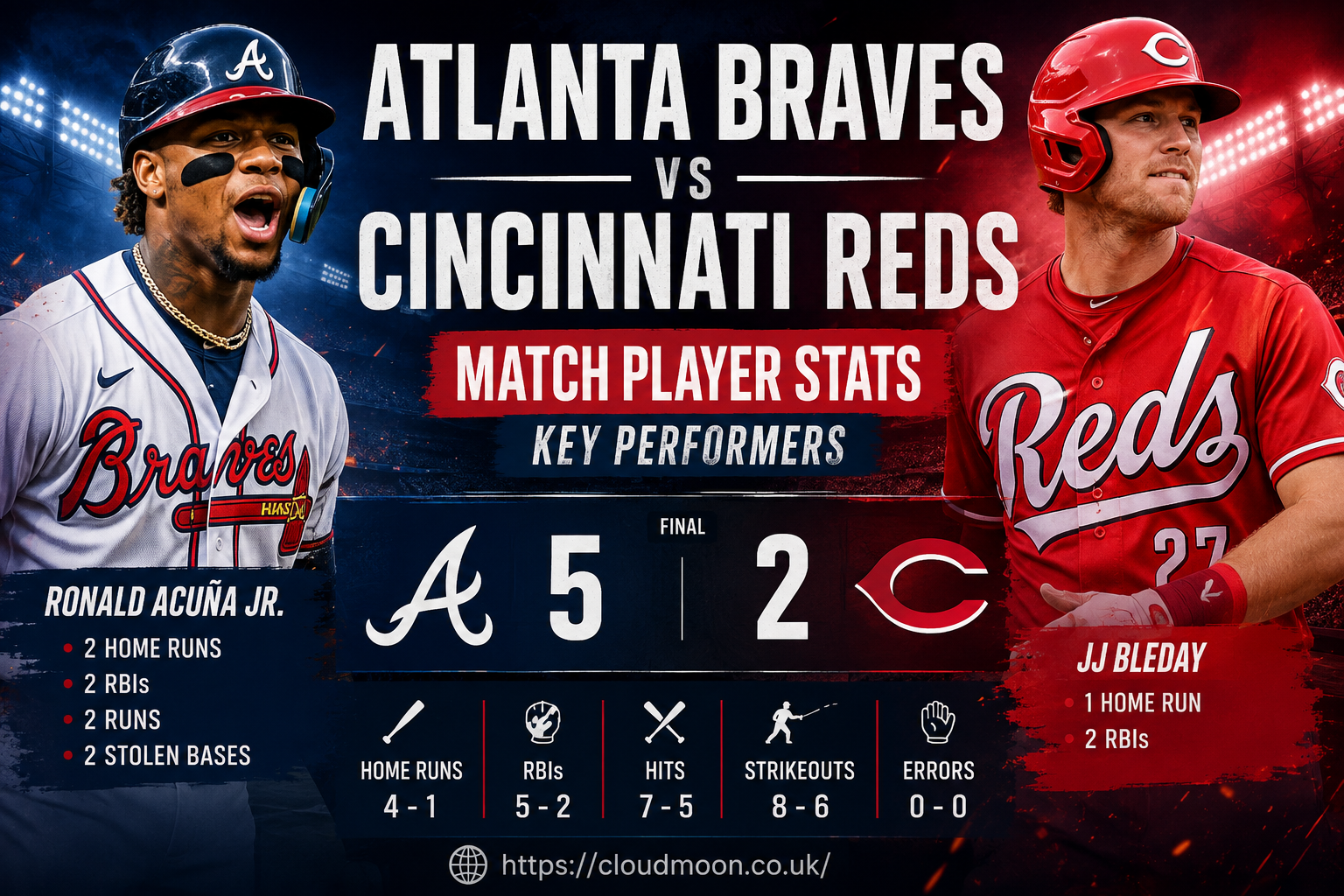
The Atlanta Braves vs Cincinnati Reds match player stats from May 30, 2026, tell the story of a game decided by timely power hitting and strong late-inning pitching. Atlanta defeated Cincinnati 5-2 at Great American Ball Park, with Ronald Acuña Jr. delivering the biggest individual performance of the night.
Acuña Jr. went 2-for-4 with two home runs, two runs scored, two RBIs, a walk, and a stolen base. Matt Olson and Jorge Mateo also homered, while Martín Pérez provided five innings of two-run baseball to earn the win.
For Cincinnati, JJ Bleday supplied the team’s only home run and drove in both Reds runs. Elly De La Cruz also contributed a triple, but Atlanta’s pitching prevented the Reds from producing another scoring opportunity after the second inning.
Atlanta Braves vs Cincinnati Reds: Match Result
The Braves won the matchup 5-2, improving to 40-19 at the time, Atlanta Braves vs Cincinnati Reds match player stats while Cincinnati fell to 29-28. Atlanta collected seven hits and committed no errors, compared with five hits for Cincinnati.
| Team | Runs | Hits | Errors |
|---|---|---|---|
| Atlanta Braves | 5 | 7 | 0 |
| Cincinnati Reds | 2 | 5 | 0 |
The score was relatively close through the middle innings, but Atlanta gradually created separation with home runs from Jorge Mateo, Matt Olson, and Acuña Jr.
The Braves scored once in the second, third, fifth, seventh, and ninth innings. Cincinnati scored both of its runs in the second inning and could not add another run during the final seven innings.
Ronald Acuña Jr. Was the Key Performer
The clearest standout in the Atlanta Braves vs Cincinnati Reds match player stats was Ronald Acuña Jr.
His final line was:
| Statistic | Acuña Jr. |
|---|---|
| At-bats | 4 |
| Hits | 2 |
| Runs | 2 |
| RBIs | 2 |
| Home Runs | 2 |
| Walks | 1 |
| Strikeouts | 1 |
| Stolen Bases | 2 |
Acuña Jr. opened his home-run account in the third inning when he sent a pitch over the right-center-field wall to tie the game at 2-2. He then struck again in the ninth, hitting his second homer of the night to give Atlanta its final 5-2 margin.
His contribution went beyond the long ball. He also walked and stole two bases, giving him an impact in multiple areas of the game. The combination of power and speed made him the most influential player on either side.
Matt Olson Added Important Power
Matt Olson provided another major moment for Atlanta.
Olson went 1-for-3 with a home run, one run scored, one RBI, and one walk. His seventh-inning homer came against Cincinnati reliever Brock Burke and extended Atlanta’s advantage to 4-2.
That at-bat was particularly important because the Braves had already taken the lead with Mateo’s fifth-inning home run. Olson’s blast gave Atlanta some much-needed breathing room before the late innings.
His overall line demonstrates why home-run production can be especially valuable in a relatively low-scoring game. Atlanta scored only five runs but received three home runs from its lineup.
Jorge Mateo Delivered a Timely Home Run
Jorge Mateo also played a significant role.
Mateo finished 1-for-4 with one run, one RBI, and one home run. His solo shot in the fifth inning moved Atlanta ahead 3-2.
While his overall hit total was modest, the timing of the home run mattered. Cincinnati had tied the game at 2-2, and Mateo’s homer immediately restored Atlanta’s lead.
This is an important distinction when evaluating player statistics: raw hit totals do not always explain the game’s momentum. A single hit at a critical point can have a much greater influence than several hits in less consequential situations.
Ozzie Albies Set the Table
Ozzie Albies did not hit a home run, but he helped initiate Atlanta’s scoring.
Albies opened the second inning with a ground-rule double. He later scored on a Mike Yastrzemski single, giving the Braves their first run.
His final line included:
- 1-for-4
- 1 run scored
- 1 double
- 3 runners left on base
The double was particularly important because it immediately put Atlanta in scoring position and helped create the game’s first run.
Mike Yastrzemski Provided a Timely RBI
Mike Yastrzemski went 1-for-3 with one RBI and one walk.
His second-inning single brought Albies home and gave Atlanta an early 1-0 lead.
Yastrzemski’s performance was a good example of complementary offense. Acuña Jr., Olson, and Mateo supplied the home-run power, while Yastrzemski contributed with a timely base hit.
Cincinnati’s JJ Bleday Was the Main Offensive Threat
JJ Bleday was Cincinnati’s most productive hitter in the matchup.
Bleday went 1-for-4 with a home run and two RBIs. His second-inning homer followed a walk by Spencer Steer and put Cincinnati ahead 2-1.
The homer was Bleday’s ninth of the season at that point, and it continued a strong stretch in which he had homered on consecutive days.
Unfortunately for Cincinnati, Bleday’s production was not matched by enough offense elsewhere in the lineup.
Elly De La Cruz Showed His Speed
Elly De La Cruz did not record an RBI, but he produced one of Cincinnati’s most notable extra-base hits.
De La Cruz hit a triple in the third inning. However, Pérez escaped the inning without allowing him to score, retiring Sal Stewart on a grounder before striking out Eugenio Suárez.
That sequence illustrates one of the game’s central themes: Cincinnati occasionally created opportunities but struggled to convert them into runs.
Martín Pérez Delivered a Solid Start
Atlanta starter Martín Pérez earned the victory with a five-inning performance.
His pitching line:
| Statistic | Martín Pérez |
|---|---|
| Innings | 5.0 |
| Hits allowed | 4 |
| Runs allowed | 2 |
| Earned runs | 2 |
| Walks | 3 |
| Strikeouts | 2 |
| Home runs allowed | 1 |
| Decision | Win |
Pérez allowed both of his runs in the second inning, when Bleday hit his two-run homer. After that, he kept Cincinnati off the scoreboard and completed five innings to qualify for the win.
His ability to settle down after the second inning was important. Atlanta’s offense eventually regained the lead, and Pérez handed that advantage to a bullpen that protected it.
Atlanta’s Bullpen Closed the Game
After Pérez left, Atlanta’s relief corps produced four consecutive scoreless innings.
| Pitcher | IP | H | R | ER | BB | K |
|---|---|---|---|---|---|---|
| Tyler Kinley | 1.0 | 0 | 0 | 0 | 0 | 1 |
| Dylan Lee | 1.0 | 1 | 0 | 0 | 0 | 1 |
| Raisel Iglesias | 1.0 | 0 | 0 | 0 | 0 | 0 |
| Raisel Iglesias* | 1.0 | 0 | 0 | 0 | 0 | 1 |
*The official pitching sequence records four scoreless relief innings overall, with Raisel Iglesias closing the ninth for his 10th save.
Atlanta’s bullpen allowed only one hit over those four innings and did not surrender a run. Iglesias finished the game with a perfect ninth and a strikeout.
Brady Singer Struggled to Match Pérez
Cincinnati starter Brady Singer took the loss.
Singer’s line was:
| Statistic | Brady Singer |
|---|---|
| Innings | 5.0 |
| Hits allowed | 4 |
| Runs allowed | 3 |
| Earned runs | 3 |
| Walks | 4 |
| Strikeouts | 2 |
| Home runs allowed | 2 |
| Decision | Loss |
Singer allowed three runs on four hits while walking four batters over five innings. He also surrendered home runs to Acuña Jr. and Jorge Mateo.
The walks were particularly costly because they gave Atlanta additional opportunities without requiring the Braves to record a hit.
Complete Braves Batting Snapshot
The most important Atlanta batting statistics from the game were:
| Player | AB | R | H | RBI | HR | BB | K |
|---|---|---|---|---|---|---|---|
| Ronald Acuña Jr. | 4 | 2 | 2 | 2 | 2 | 1 | 1 |
| Michael Harris II | 4 | 0 | 0 | 0 | 0 | 1 | 2 |
| Matt Olson | 3 | 1 | 1 | 1 | 1 | 1 | 0 |
| Ozzie Albies | 4 | 1 | 1 | 0 | 0 | 0 | 0 |
| Dominic Smith | 4 | 0 | 0 | 0 | 0 | 0 | 0 |
| Mauricio Dubón | 3 | 0 | 1 | 0 | 0 | 1 | 1 |
| Mike Yastrzemski | 3 | 0 | 1 | 1 | 0 | 1 | 0 |
| Jorge Mateo | 4 | 1 | 1 | 1 | 1 | 0 | 1 |
These figures show that Atlanta’s offense was concentrated around several timely contributions rather than a large number of hits. Acuña Jr. generated the biggest individual production, while Olson, Mateo, and Yastrzemski supplied the additional run-producing plays.
Complete Reds Offensive Snapshot
Cincinnati’s offense was much quieter:
| Player | AB | Key contribution |
|---|---|---|
| Blake Dunn | 3 | 1 double |
| Elly De La Cruz | 4 | 1 triple |
| Sal Stewart | 4 | — |
| Eugenio Suárez | 4 | — |
| Spencer Steer | 3 | Walk |
| JJ Bleday | 4 | Home run, 2 RBIs |
| Tyler Stephenson | 3 | — |
| Matt McLain | 2 | — |
| TJ Friedl | 3 | — |
Bleday’s home run accounted for both Cincinnati RBIs, while De La Cruz and Dunn provided the team’s other notable extra-base hits.
What Decided the Game?
Three factors explain the final result particularly well.
1. Atlanta Won the Home-Run Battle
The Braves hit four home runs compared with one for Cincinnati. Acuña Jr. hit two, while Olson and Mateo each added one. Bleday hit Cincinnati’s lone homer.
2. Atlanta’s Bullpen Protected the Lead
Cincinnati scored twice in the second inning but was shut out from the third inning onward. Atlanta’s relief pitchers played a major part in preserving the advantage.
3. Atlanta Capitalized on Timely Opportunities
The Braves did not need a huge hit advantage. Instead, their biggest hits came at important moments: Acuña Jr.’s third-inning homer tied the game, Mateo’s fifth-inning homer restored the lead, Olson’s seventh-inning homer extended it, and Acuña Jr.’s ninth-inning homer provided insurance.
Why These Player Stats Matter
A box score gives the basic numbers, Atlanta Braves vs Cincinnati Reds match player stats but understanding the context makes those numbers more useful.
For example, Acuña Jr.’s two home runs clearly stand out, but his walk and stolen bases also demonstrate how he affected the game when he did not record a hit. Similarly, Albies’ double did not produce an RBI, yet it directly helped create Atlanta’s opening run.
On Cincinnati’s side, Bleday’s two-RBI homer was valuable even though it represented the team’s only home run and one of only five total hits.
For readers tracking MLB performances, this is why it is useful to examine at-bats, runs, hits, RBIs, home runs, walks, strikeouts, extra-base hits, and pitching innings together rather than relying on a single statistic.
Frequently Asked Questions
Who was the best player in the Braves vs Reds game?
Ronald Acuña Jr. was the standout player. He went 2-for-4 with two home runs, two RBIs, two runs scored, a walk, and two stolen bases.
What was the final score of the Braves vs Reds game?
The Atlanta Braves defeated the Cincinnati Reds 5-2 on May 30, 2026, at Great American Ball Park.
How many home runs did Ronald Acuña Jr. hit?
Acuña Jr. hit two home runs. His first tied the game in the third inning, while his second came in the ninth inning.
Who hit home runs for the Braves?
Ronald Acuña Jr. hit two home runs, while Matt Olson and Jorge Mateo each hit one.
Who hit the Reds’ home run?
JJ Bleday hit Cincinnati’s only home run. His second-inning shot drove in Spencer Steer and accounted for both Reds RBIs.
Who was the winning pitcher?
Martín Pérez earned the victory for Atlanta. He pitched five innings, allowing four hits and two earned runs while striking out two.
Who recorded the save for Atlanta?
Raisel Iglesias closed the ninth inning and recorded his 10th save of the season.
How did Elly De La Cruz perform?
De La Cruz went 1-for-4 and hit a triple. He did not score or drive in a run, as Atlanta’s pitching stranded him after his third-inning extra-base hit.
Conclusion
The Atlanta Braves vs Cincinnati Reds match player stats from May 30, 2026, show a game where Atlanta combined timely power hitting with dependable pitching to secure a 5-2 victory.
Ronald Acuña Jr. was unquestionably the headline performer. His two home runs, two RBIs, two runs, walk, and two stolen bases made him the central figure in Atlanta’s offensive success. Matt Olson and Jorge Mateo added important solo home runs, while Ozzie Albies and Mike Yastrzemski helped create the early scoring.
Martín Pérez also played an important role by limiting Cincinnati to two runs across five innings. Once he departed, Atlanta’s bullpen kept the Reds scoreless for the remainder of the game, with Raisel Iglesias finishing the job in the ninth.