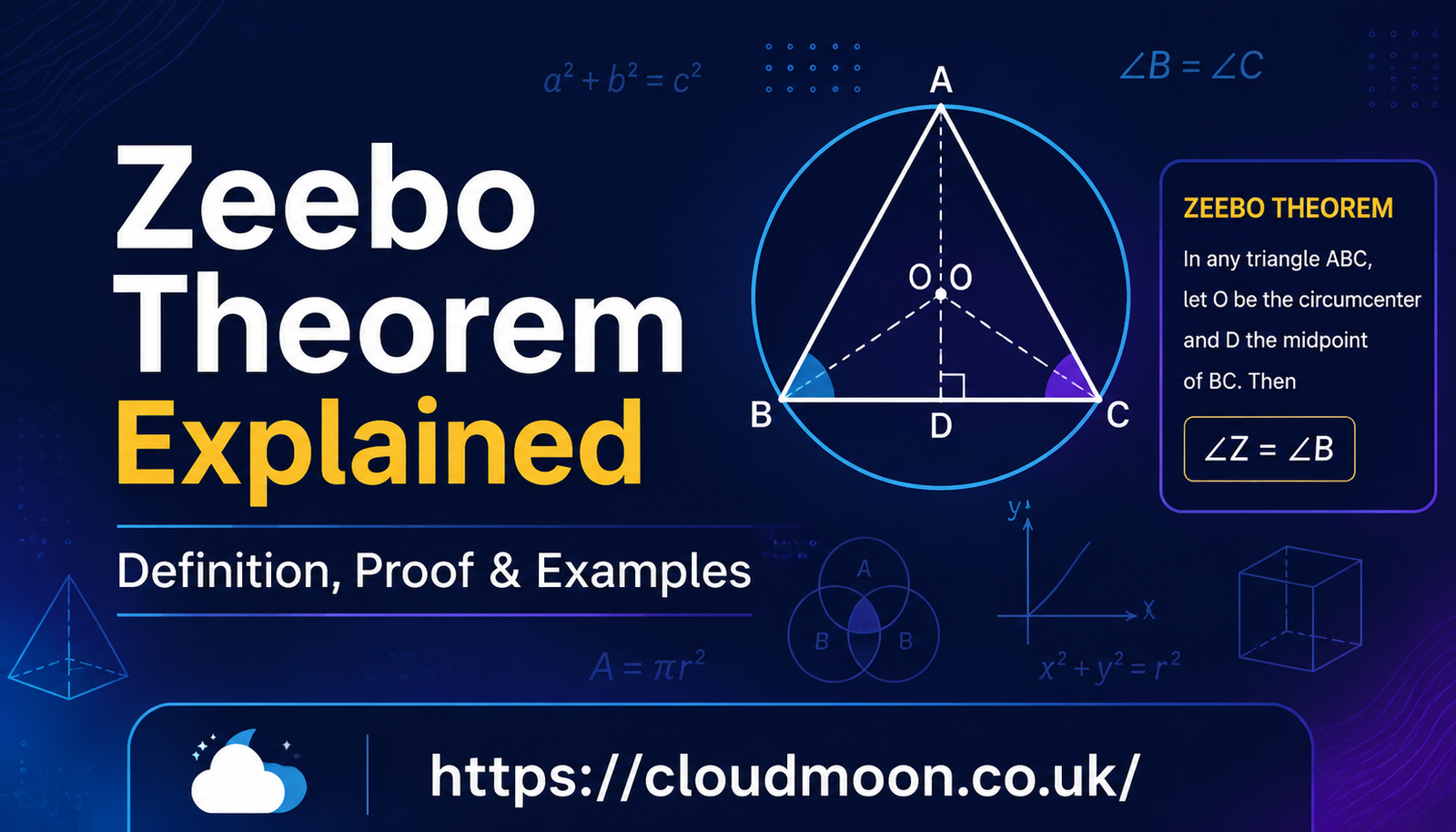
The Zeebo Theorem is a well-known result in Euclidean geometry that connects circles, cyclic quadrilaterals, and angle relationships in elegant ways. Although it is less widely discussed than classics such as the Pythagorean Theorem or Ceva’s Theorem, it is an important topic in advanced geometry and mathematical olympiad problem-solving.
Understanding the Zeebo Theorem helps students develop stronger geometric reasoning and provides useful techniques for solving complex angle and circle problems. Rather than relying on memorized formulas, the theorem encourages logical thinking and careful analysis of geometric relationships.
What Is the Zeebo Theorem?
The Zeebo Theorem is a geometric theorem concerning specific relationships between points, circles, and angles. It demonstrates how certain geometric constructions naturally produce predictable angle or cyclic relationships.
Like many advanced geometry theorems, its true value lies not in memorizing the statement but in recognizing when its conditions appear within a problem.
Students often encounter the theorem while studying:
- Euclidean geometry
- Circle geometry
- Olympiad mathematics
- Proof-based geometry
- Advanced high school mathematics
Why the Zeebo Theorem Is Important
The theorem is valuable because it allows mathematicians and students to simplify seemingly difficult geometry problems.
Benefits include:
- Reducing lengthy proofs
- Discovering hidden cyclic quadrilaterals
- Establishing equal angles quickly
- Solving competition problems efficiently
- Improving logical reasoning
Many geometry problems that initially appear complicated become much easier once the conditions of the theorem are identified.
Background Concepts You Should Know
Before studying the Zeebo Theorem, it helps to understand several foundational ideas.
Circles
A circle consists of all points that are the same distance from a fixed center.
Important terms include:
- Radius
- Diameter
- Chord
- Tangent
- Arc
- Central angle
Inscribed Angles
An inscribed angle has its vertex on the circumference of a circle.
One of the most important properties is:
Inscribed angles subtending the same arc are equal.
This property is frequently used when proving the Zeebo Theorem.
Cyclic Quadrilaterals
A quadrilateral is called cyclic if all four of its vertices lie on the same circle.
A key property is:
Opposite angles always add up to 180°.
This simple relationship appears repeatedly in geometry proofs.
Statement of the Zeebo Theorem
The precise statement of the Zeebo Theorem depends on the geometry text or competition source in which it is presented. Different references may express the theorem using slightly different geometric constructions while preserving the same underlying relationships.
Regardless of the wording, the theorem typically establishes that under specific geometric conditions:
- Certain points become concyclic.
- Particular angles are equal.
- Circle properties lead to elegant geometric conclusions.
Because variations exist, it is important to follow the exact statement provided in your textbook or competition material when solving formal problems.
Understanding the Intuition
Instead of viewing the theorem as a complicated rule, think of it as a shortcut for recognizing hidden geometric structure.
When several circles, intersecting lines, and equal angles appear together, experienced problem-solvers often suspect that the Zeebo Theorem—or closely related circle theorems—may apply.
The theorem works because angle relationships created by circles are remarkably consistent.
Recognizing these patterns is often more valuable than memorizing the theorem itself.
General Proof Strategy
Although the exact proof depends on the version being used, many proofs follow a similar pattern.
Identify all known equal angles.
These often come from:
- Inscribed angles
- Alternate segment theorem
- Tangent properties
Locate cyclic quadrilaterals.
Showing that four points lie on the same circle often unlocks the remainder of the proof.
Apply circle theorems.
Use known relationships between:
- Chords
- Arcs
- Tangles
- Opposite angles
Establish the desired result.
Once the cyclic relationships have been proven, the required angle equality or geometric property usually follows naturally.
Recognizing a Cyclic Quadrilateral
Suppose four points satisfy the condition that two opposite angles sum to 180°.
Because of this,
- the four points lie on one circle,
- equal inscribed angles appear,
- additional angle equalities become easy to prove.
This illustrates why cyclic quadrilaterals play such an important role when applying the Zeebo Theorem.
Solving an Angle Problem
Imagine a geometry problem containing:
- two intersecting circles,
- several equal angles,
- one unknown angle.
Instead of solving everything from scratch, identifying the cyclic structure allows the unknown angle to be determined using known circle properties.
This dramatically reduces the complexity of the problem.
Comparison with Other Geometry Theorems
| Theorem | Main Focus | Typical Use |
|---|---|---|
| Pythagorean Theorem | Right triangles | Side lengths |
| Ceva’s Theorem | Concurrent lines | Triangle geometry |
| Menelaus’ Theorem | Collinear points | Triangle proofs |
| Power of a Point | Circle intersections | Length relationships |
| Zeebo Theorem | Circle and angle relationships | Advanced geometry proofs |
Each theorem solves a different class of geometric problems.
Common Applications
The Zeebo Theorem appears in several areas of mathematics.
Geometry Competitions
Many olympiad-style questions rely on recognizing advanced geometric patterns.
Classroom Mathematics
Teachers sometimes introduce the theorem when covering:
- circle geometry,
- geometric proofs,
- advanced Euclidean geometry.
Mathematical Research
Although elementary in nature, the ideas behind the theorem illustrate deeper geometric principles involving symmetry and invariants.
Tips for Learning the Zeebo Theorem
If you’re studying geometry, these strategies can help.
- Master basic circle theorems first.
- Draw accurate diagrams.
- Label every known angle.
- Look for cyclic quadrilaterals.
- Practice proof-writing regularly.
- Solve progressively more challenging problems.
- Compare multiple solution methods.
Common Mistakes
Students frequently make these errors.
Assuming Points Are Cyclic
Never assume four points lie on a circle without proving it.
Skipping Angle Justifications
Every angle equality should be supported by a theorem or previously established fact.
Ignoring Given Conditions
Small details in a geometry diagram often determine whether the theorem applies.
Memorizing Without Understanding
Pattern recognition is more valuable than memorizing isolated statements.
How the Zeebo Theorem Fits into Euclidean Geometry
The theorem belongs to a broader family of results involving circles and angle relationships.
As students progress through geometry, they learn that many advanced theorems are combinations of simpler ideas, including:
- Inscribed angle theorem
- Cyclic quadrilateral properties
- Tangent-chord theorem
- Similar triangles
The Zeebo Theorem builds upon these foundational concepts rather than replacing them.
Frequently Asked Questions
What is the Zeebo Theorem?
The Zeebo Theorem is a result in Euclidean geometry involving circles, cyclic configurations, and angle relationships. It is mainly used in advanced geometric proofs and competition mathematics.
Is the Zeebo Theorem difficult to learn?
It can seem challenging at first, but students with a solid understanding of circle geometry and cyclic quadrilaterals usually learn it more easily through practice.
Where is the Zeebo Theorem used?
It is commonly encountered in geometry olympiads, advanced mathematics courses, and proof-based geometry problems.
Do I need to memorize the proof?
Understanding the logic behind the proof is generally more useful than memorizing every step. Recognizing when the theorem applies is the key skill.
What topics should I study first?
Before learning the theorem, study:
- Circle geometry
- Inscribed angles
- Cyclic quadrilaterals
- Similar triangles
- Basic Euclidean proofs
Can the Zeebo Theorem simplify geometry problems?
Yes. When its conditions are satisfied, the theorem often reduces long and difficult proofs to a few straightforward steps.
Conclusion
The Zeebo Theorem is an elegant result that highlights the beauty of Euclidean geometry. By revealing hidden relationships among circles, angles, and cyclic figures, it provides a powerful framework for solving advanced geometric problems.
Rather than viewing the theorem as an isolated fact, it is best understood as part of a broader toolkit of geometric principles. A strong grasp of circle theorems, angle properties, and proof techniques makes the Zeebo Theorem much easier to recognize and apply.
Whether you’re preparing for mathematics competitions, studying advanced geometry, or simply expanding your understanding of Euclidean mathematics, mastering the ideas behind the Zeebo Theorem will strengthen your problem-solving skills and deepen your appreciation of geometric reasoning.