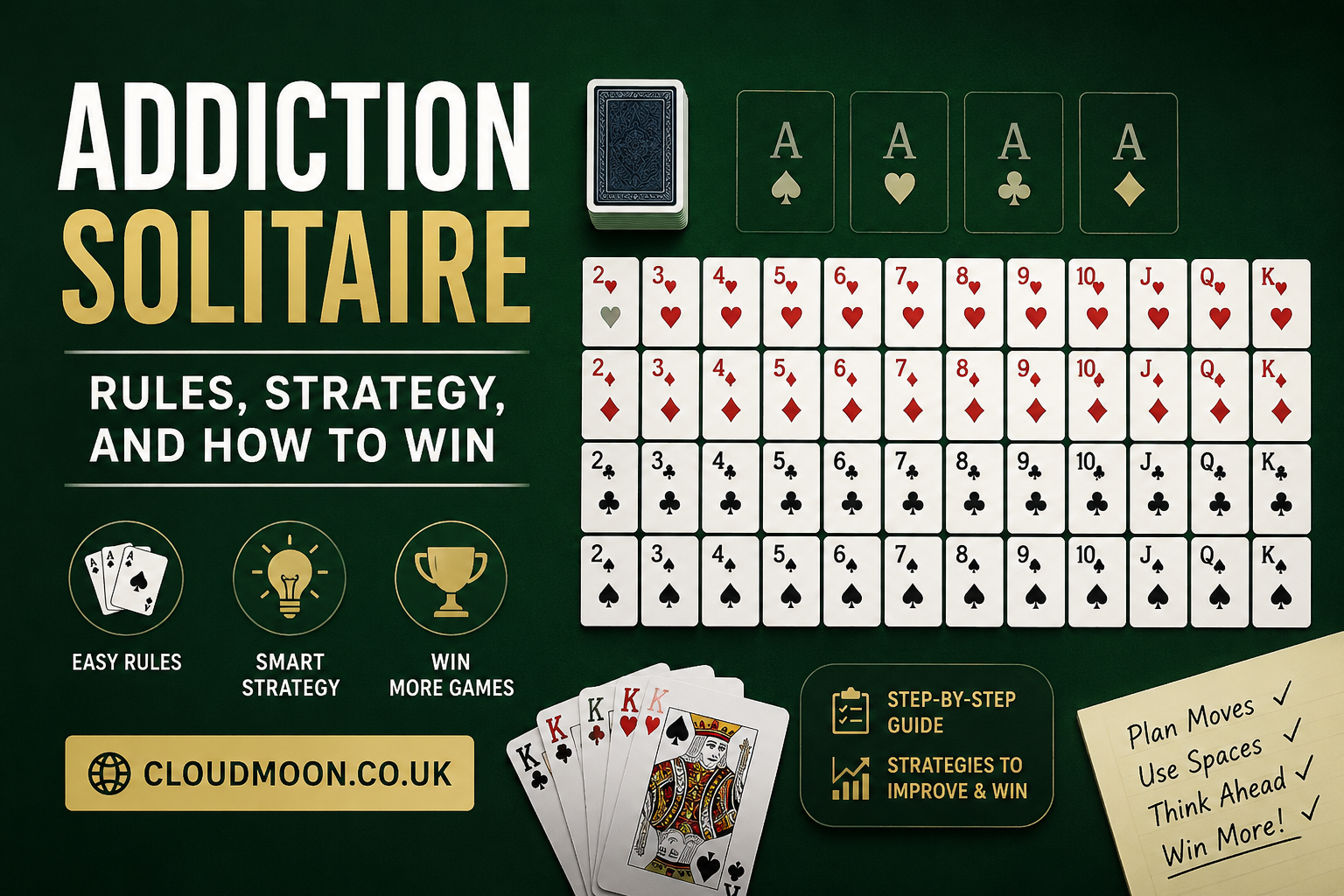
Addiction Solitaire is a fast-paced single-player card game that rewards careful planning, logical thinking, and patience. While it may look similar to traditional Solitaire at first glance, its unique gameplay mechanics make it a completely different challenge.
Unlike games that rely heavily on luck, Addiction Solitaire gives players opportunities to improve their odds through smart decision-making. Understanding how the game works, recognizing strategic patterns, and knowing when to reset the layout can significantly increase your chances of winning.
What Is Addiction Solitaire?
Addiction Solitaire is a patience card game that challenges players to arrange cards in numerical order within their respective suits. The game gets its name from its highly engaging gameplay, which often encourages players to try “just one more game.”
Unlike Classic Solitaire (Klondike), where cards are stacked into foundations, Addiction Solitaire keeps every card on the tableau. Empty spaces become essential tools for rearranging cards until each row is perfectly ordered.
Although luck affects the initial deal, skill has a much greater influence on the final outcome.
Objective of Addiction Solitaire
The goal is simple:
Arrange every row so that cards appear in ascending order by suit.
For example:
| Correct Sequence |
|---|
| Ace, 2, 3, 4, 5, 6, 7, 8, 9, 10, Jack, Queen, King |
Each row must contain cards from only one suit.
When all four rows are correctly organized, you win the game.
Game Setup
Addiction Solitaire uses:
- One standard 52-card deck
- Four horizontal rows
- Thirteen cards per row
At the beginning of the game:
- All cards are dealt face up.
- The four Aces are removed immediately.
- Removing the Aces leaves four empty spaces.
These empty spaces become the primary way to move cards around the board.
Addiction Solitaire Rules
Learning the rules is straightforward.
Move Cards Into Empty Spaces
Only one card can be moved into an empty space.
Cards Must Continue the Same Suit
A card can only fill an empty space if it continues the sequence of the card immediately to its left.
Example:
If the card to the left is:
- 5 of Hearts
Then only:
- 6 of Hearts
can occupy the empty space.
No other card is legal.
Empty Spaces at the Start of a Row
If an empty space is the first position in a row, only a Two may be placed there.
Since the Ace has been removed, the Two becomes the starting card.
Kings Cannot Move
Kings cannot be placed into an empty space because no card follows a King.
They effectively act as sequence endpoints.
Redeals
When no legal moves remain, the game allows a limited number of redeals.
During a redeal:
- Correctly ordered sequences stay in place.
- Remaining cards are shuffled.
- Cards are redealt into the unfinished spaces.
Most versions provide three redeals, though this can vary depending on the platform.
Understanding Empty Spaces
Empty spaces are the heart of Addiction Solitaire.
Every move revolves around creating and using these spaces effectively.
Think of them as temporary storage locations that help you reposition cards into their correct sequences.
Players who use empty spaces strategically usually outperform those who simply make the first available move.
Basic Strategy for Beginners
Build Long Sequences Early
Focus on extending ordered runs instead of moving isolated cards.
Long sequences reduce future complications.
Protect Valuable Spaces
Avoid filling an empty space immediately unless it creates meaningful progress.
Sometimes waiting leads to a stronger move.
Think Several Moves Ahead
Rather than asking,
“What move can I make?”
ask,
“What sequence will this create?”
Planning ahead often prevents dead ends.
Don’t Rush Redeals
Many players use redeals too early.
Before reshuffling:
- Double-check every row.
- Look for hidden legal moves.
- Evaluate whether moving another card opens new possibilities.
Advanced Winning Strategies
Experienced players rely on deeper planning.
Prioritize Lower Cards
Low-value cards are harder to reposition later.
Getting Twos through Sixes into place early makes building longer sequences much easier.
Keep Suits Organized
Avoid creating fragmented suit sequences.
A scattered suit often requires multiple redeals to fix.
Watch for Blocked Kings
Kings frequently trap useful spaces.
Try to arrange rows so Kings naturally finish completed suit sequences.
Create Flexible Positions
Leave yourself multiple legal moves whenever possible.
Having options reduces the likelihood of becoming stuck.
Common Mistakes Players Make
Many losses happen because of avoidable errors.
Moving Too Quickly
Fast decisions often overlook better opportunities.
Pause before every move.
Ignoring Long-Term Planning
A move that looks helpful now may block several future moves.
Wasting Empty Spaces
Every empty position is valuable.
Use them to improve sequences—not simply because they’re available.
Redealing Too Soon
Many games remain solvable without reshuffling.
Carefully inspect the tableau before using a redeal.
Example Gameplay
Imagine this partial row:
2♦ 3♦ 4♦ 5♦ [Empty]
Only the 6♦ can legally occupy the empty space.
Suppose another row contains:
6♦ 8♣ 9♣
Moving the 6♦ completes the diamond sequence while opening another space for future rearrangement.
Simple decisions like this gradually build complete rows.
Addiction Solitaire vs Classic Solitaire
| Feature | Addiction Solitaire | Classic Solitaire |
|---|---|---|
| Goal | Arrange suit sequences | Build foundation piles |
| Hidden Cards | No | Yes |
| Skill Level | High | Moderate |
| Luck Factor | Moderate | Higher |
| Redeals | Limited | Depends on variation |
| Empty Spaces | Core mechanic | Limited importance |
Players who enjoy puzzles and planning often prefer Addiction Solitaire because nearly every move requires strategic thinking.
Tips to Improve Your Winning Percentage
Improving takes practice and observation.
Here are some habits that consistently help:
- Study the entire board before moving.
- Focus on completing one sequence at a time.
- Avoid breaking useful runs unnecessarily.
- Delay redeals until every possible move has been explored.
- Learn from unsuccessful games.
- Practice regularly to recognize common patterns.
- Stay patient instead of chasing quick moves.
Is Addiction Solitaire Mostly Luck or Skill?
The answer is both—but skill plays the larger role over time.
Luck determines the starting layout and the outcome of redeals. However, experienced players consistently achieve higher win rates because they:
- Plan ahead.
- Recognize efficient move sequences.
- Manage empty spaces effectively.
- Avoid unnecessary mistakes.
As your understanding of the game’s mechanics improves, your results become more consistent.
Why Addiction Solitaire Remains Popular
Several factors contribute to its lasting appeal:
- Easy to learn but difficult to master.
- Every game presents a unique challenge.
- Strategic gameplay rewards thoughtful decision-making.
- Short game sessions fit into busy schedules.
- Winning feels genuinely satisfying because success depends on planning as much as luck.
Its balance of accessibility and depth has made it a favorite among casual players and puzzle enthusiasts alike.
Frequently Asked Questions
1. Is Addiction Solitaire difficult to learn?
No. The basic rules are simple, but mastering the game’s strategy takes practice and experience.
2. Can every game of Addiction Solitaire be won?
No. Some starting layouts are impossible to solve, even with perfect play. Skill improves your chances, but it cannot overcome every deal.
3. How many redeals do you get?
Most versions offer up to three redeals, although the exact number depends on the software or website you’re using.
4. Why can’t Kings move into empty spaces?
A King is the highest-ranking card. Since no card comes after it, placing a King into an empty space would prevent the sequence from continuing.
5. What’s the biggest strategy mistake beginners make?
Using empty spaces too quickly without considering future moves is one of the most common and costly mistakes.
6. Is Addiction Solitaire suitable for beginners?
Yes. New players can learn the rules quickly, while the game’s strategic depth keeps it engaging as their skills improve.
7. Does winning depend more on luck or strategy?
Luck influences the initial deal, but strategy has a greater impact on long-term success. Experienced players generally achieve better results through careful planning and efficient use of empty spaces.
Conclusion
Addiction Solitaire is more than a simple card game—it’s a rewarding exercise in logic, planning, and patience. While the rules are easy to understand, consistently winning requires thoughtful decision-making, careful management of empty spaces, and a willingness to think several moves ahead.
By mastering the core rules, learning when to redeal, avoiding common mistakes, and applying proven strategies, you’ll steadily improve your performance and enjoy the game even more. Whether you’re a beginner looking to understand the basics or an experienced player aiming to increase your win rate, Addiction Solitaire offers a satisfying challenge that rewards skill, persistence, and strategic thinking with every game.