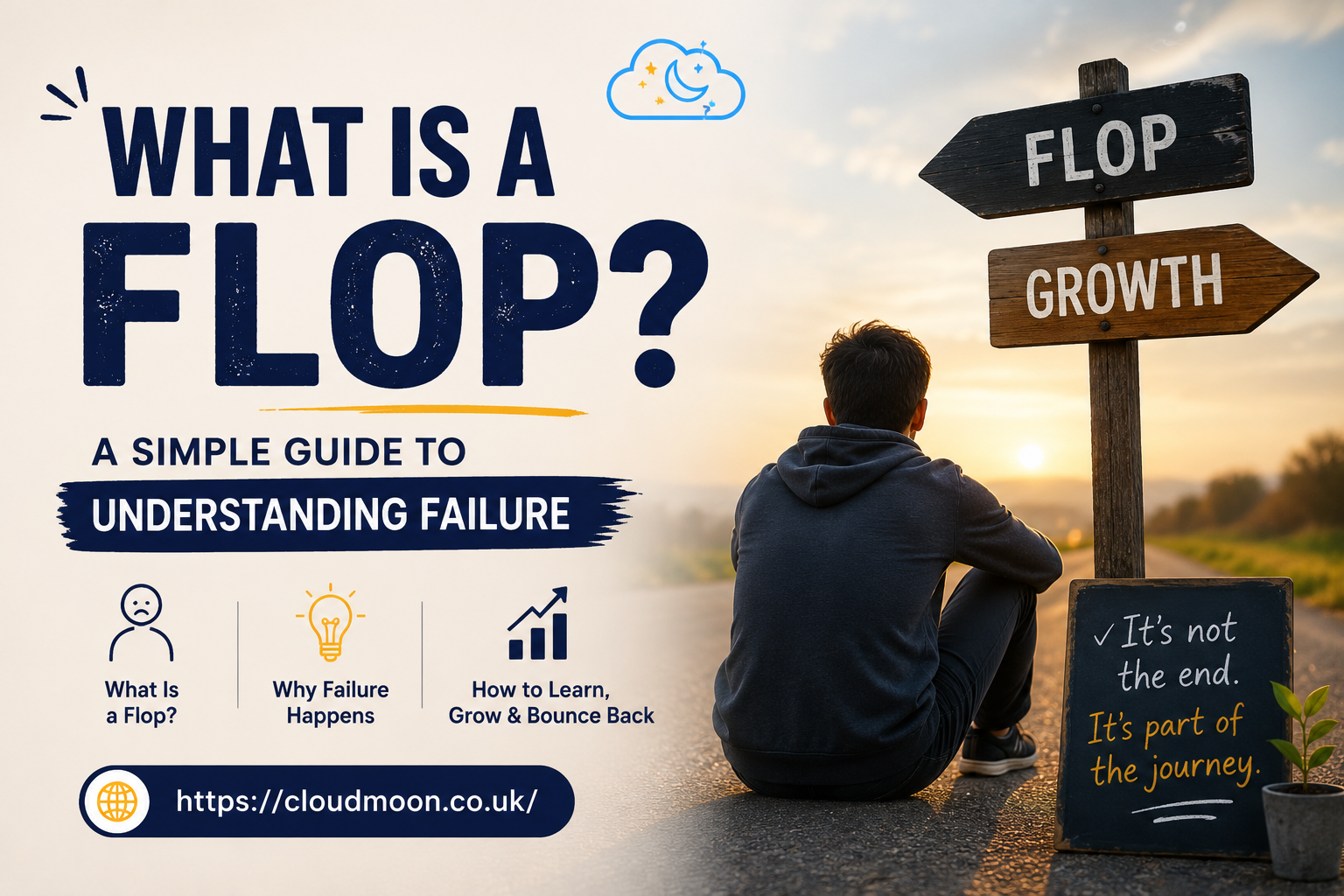
A flop is a word people often use when something fails to achieve the expected level of success. It can describe a movie that loses money, a product that does not attract customers, a business idea that does not work, or even a personal project that falls short of its goals.
Failure is a common part of innovation, creativity, and decision-making. Understanding what makes something a flop can help people recognize mistakes, improve future strategies, and make better choices.
But what exactly does flop mean? Why do some projects become successful while others fail? Is every failure truly a flop, or can setbacks provide valuable lessons?
This guide explains the meaning of a flop, explores different types of failures, provides real-world examples, and shows how understanding failure can lead to better results.
What Is a Flop?
The term flop describes something that is unsuccessful or performs much worse than expected. The word is commonly used when there is a noticeable gap between expectations and actual results.
For example, if a movie studio spends millions promoting a film but very few people watch it, the movie may be called a flop. Similarly, if a company launches a product expecting huge sales but customers show little interest, that product may be considered a flop.
A flop is usually connected with disappointment because people expected a better outcome. However, the word does not always mean complete failure. Sometimes a flop can still generate attention, influence future decisions, or become valuable over time.
The Meaning of Flop in Different Contexts
The meaning of Flop depends on where the word is used. Here are some common examples:
| Context | Meaning of Flop | Example |
|---|---|---|
| Movies and entertainment | A film or show that performs poorly financially or receives negative reactions | A movie that earns far less than its production cost |
| Business | A product, service, or strategy that fails commercially | A product that attracts few buyers |
| Sports | A poor performance by an athlete or team | A highly expected player having a disappointing season |
| Everyday life | A plan or attempt that does not succeed | An event with very low attendance |
Understanding the context helps determine why something is considered a flop.
Why Do Things Become Flops?
Many different factors can turn an expected success into a failure. A flop rarely happens because of one single reason. Usually, several problems combine to create disappointing results.
1. Poor Planning and Research
One of the biggest reasons behind a flop is insufficient preparation.
Businesses, filmmakers, and creators often invest time and money based on assumptions instead of understanding their audience. Without proper research, they may create something people do not actually want.
Examples include:
- Launching a product without studying customer needs
- Creating content for the wrong audience
- Entering a market without understanding competition
Good research helps reduce the risk of failure.
2. Weak Execution
Even a strong idea can become a flop if it is poorly executed.
A product may have an excellent concept but fail because of:
- Low quality
- Poor design
- Weak marketing
- Bad customer experience
- Technical problems
Success depends not only on having a good idea but also on delivering it effectively.
3. Wrong Timing
Timing plays an important role in success and failure.
Sometimes an idea is not successful because the market is not ready for it. A product may be innovative but introduced before customers understand its value.
On the other hand, launching too late can mean facing stronger competition.
A flop caused by timing does not necessarily mean the idea itself was bad.
4. Failure to Understand the Audience
Many flops happen because creators misunderstand what people want.
A successful product, movie, or service must connect with its target audience. If it does not solve a problem, provide entertainment, or offer value, people may ignore it.
Understanding customer behavior, preferences, and expectations is essential.
Famous Examples of Flops
Many well-known failures have become important learning examples. These cases show that even experienced companies and creators can make mistakes.
Entertainment Flops
In the movie industry, a film can become a flop when production costs are much higher than box office earnings.
Common reasons include:
- Poor audience reception
- Weak storytelling
- High competition
- Unrealistic expectations
A movie may also fail commercially despite having talented actors or a large marketing budget.
Business and Product Flops
Companies sometimes launch products that fail because they do not meet customer needs.
Examples of common product failure reasons include:
- Lack of demand
- High pricing
- Poor user experience
- Stronger alternatives from competitors
A failed product can still teach companies valuable lessons about innovation and customer behavior.
Flop vs Failure: Is There a Difference?
Although the words are often used interchangeably, there is a slight difference between a flop and a general failure.
| Flop | Failure |
|---|---|
| Usually refers to a disappointing result compared with expectations | A broader term for something that does not succeed |
| Often involves public attention or disappointment | Can happen privately without outside awareness |
| Commonly used for movies, products, and major projects | Applies to almost any unsuccessful attempt |
For example, a small personal goal that is not achieved may be called a failure, but a highly promoted product that receives poor sales may be called a flop.
Can a Flop Become Successful Later?
Yes, some things considered flops initially can gain appreciation over time.
A flop can later become valuable because:
- Audiences change
- New technology creates opportunities
- People discover hidden value
- Lessons from failure improve future work
History has many examples of ideas that were ignored at first but later became respected.
This shows that a flop is not always the final outcome. Sometimes it is simply part of a longer journey.
How to Learn From a Flop
Failure becomes useful when people analyze what went wrong and apply those lessons.
Here are practical ways to learn from a flop:
Review the Results
Look at the facts instead of focusing only on disappointment.
Ask:
- What expectations were not met?
- Where did performance decline?
- What feedback did people provide?
Identify the Main Problems
Understanding the cause is more valuable than simply labeling something a failure.
Possible causes include:
- Poor strategy
- Lack of preparation
- Incorrect assumptions
- Weak communication
Improve Future Decisions
The biggest benefit of studying a flop is creating better strategies for the future.
Successful individuals and organizations often use past mistakes to improve their next attempts.
Why Understanding Flops Matters
Learning about flops helps people develop realistic expectations.
Success stories often receive the most attention, but failures can provide equally valuable knowledge. They reveal what does not work and highlight areas where improvement is needed.
Whether in business, entertainment, sports, or personal goals, understanding failure encourages better planning and smarter decisions.
Frequently Asked Questions
What is the simple meaning of flop?
A flop means something that fails to achieve the expected success, popularity, or results.
Is a flop always a failure?
Yes, a flop is usually considered a type of failure, but it does not always mean something has no value. Many flops provide important lessons.
Why do movies become flops?
Movies often become flops because of high production costs, low audience interest, poor reviews, weak marketing, or strong competition.
Can a business recover after a flop?
Yes. Many businesses recover by learning from mistakes, improving products, changing strategies, and understanding customers better.
What is the opposite of a flop?
The opposite of a flop is a success, hit, breakthrough, or achievement.
Is flop only used for business and movies?
No. The word flop can describe failures in many areas, including sports, projects, events, and personal attempts.
Does a flop mean an idea was bad?
Not always. Sometimes a good idea fails because of poor timing, execution problems, or market conditions.
Conclusion
A flop describes something that fails to meet expectations, but failure does not always mean the end of the story. Whether it happens in movies, business, products, sports, or personal projects, a flop can reveal important lessons.
Understanding why things fail helps people make better decisions, improve strategies, and avoid repeating the same mistakes. Successful outcomes often come from learning, adapting, and using past experiences as guidance.
A flop may represent disappointment in the short term, but it can also become a valuable opportunity for growth and improvement.